
Parameters
Joint Type
Classic finger joints on all edges — for gluing
Dimensions
All dimensions are interior — a standard tissue pack needs approx. 234 × 116 × 58 mm
Longest side — the tissue pack lies along it
Lid
Elliptical tissue opening along the width
Tissue opening along the depth
Lid overhangs the body all around — carries the outer web of the tab slots
Rounds the corners with r = material thickness — the lid always, with the enclosed build also the end walls
Retention tabs on the end walls: 58mm long, protrude one material thickness above the lid (rounded tops)
Material
Plywood 3–4 mm is ideal
Cut width of your tool — contours are offset outward by kerf/2
Spacing between parts in the cut layout
Finger joints
Target finger width (distributed along the edges)
Minimum number of fingers per edge
Tissue Box Designer
Design a tissue box with classic finger joints: the lid rests on the walls and is held by two centered retention tabs on the end walls – they pass through lid slots, protrude one material thickness and have rounded tops. The elliptical tissue opening and the lid overhang are freely adjustable; the defaults fit a standard tissue pack.
Slip-on lid
No hinge, no glue on the lid: it rests on the wall edges and is centered by two rounded retention tabs – simply lift it off to refill.
Elliptical tissue opening
Opening length and width are freely adjustable as a clean polyline ellipse – the validation keeps sufficient webs to the slots and edges.
Finger-jointed or enclosed
Body with finger joints for gluing – or the enclosed construction: end walls wrap around front and back, the bottom sits in slots, and the lid locks everything without glue. Export as SVG, DXF, PDF, STEP or STL.
Tips for tissue boxes
- Pack size: The defaults fit a standard rectangular pack of about 230 × 115 × 55 mm. Measure your pack and add a few millimetres of clearance in each direction.
- Opening: An opening of roughly 120 × 45 mm pulls single tissues cleanly; make it wider for thick tissues so they do not tear.
- Material: 3–4 mm plywood or acrylic. The retention tabs protrude one material thickness above the lid – rounded tops are part of the design.
- Enclosed build: Choose it when you want smooth outer walls: the lid holds the body together, so you can even skip the glue.
Laser cutter settings
- Kerf: Enter the full kerf width of your laser, typically 0.1–0.2 mm. The fingers are widened by that amount so the joint closes tight. Cut a small test corner before the whole box.
- Material: Measure the real sheet thickness with calipers and enter that value: nominal 3 mm plywood is often 2.7–3.2 mm, and the fit of finger joints (box joints) depends on it.
- Export: SVG for LightBurn, xTool Creative Space or Glowforge, DXF for CAD, PDF to check the layout. All files are at 1:1 scale in millimetres; cut inner contours before outlines.
- Corners: No dogbones or corner relief needed: the narrow laser kerf cuts the inside corners of the joints sharp. Corner relief is only a CNC router topic.
Made with this tool
All makes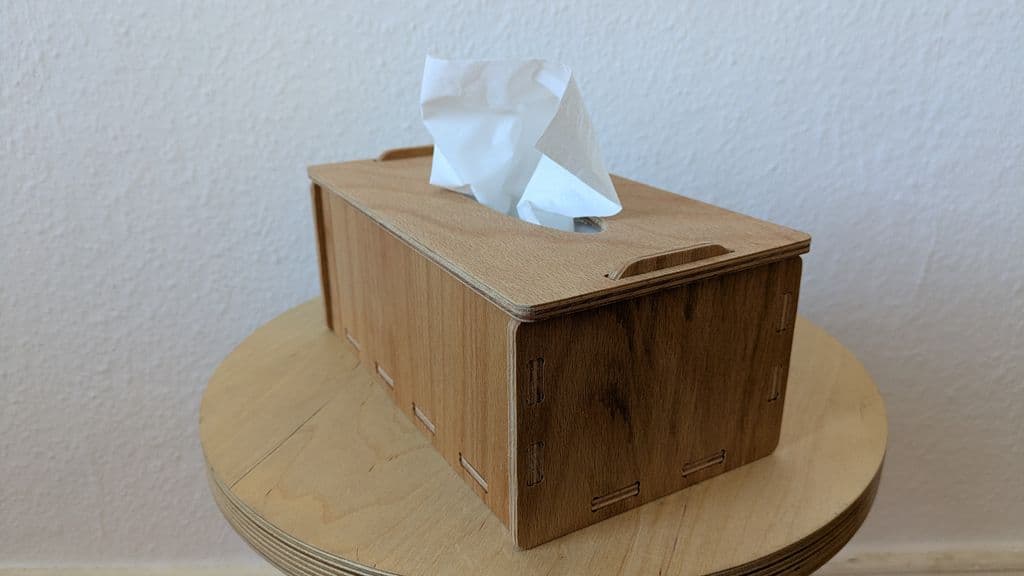
Design for free in the tool above, export as SVG, DXF or PDF. See all tools or compare plans.